Saturday, February 21, 2009

Into My Hypercube: Voivod and the Critique of Techno-worship

I walked to the bank this morning and that short 20 minute journey inspired me to sit down and form pages of notes and ideas into this essay. I live in a city a hundred years dead; when the textile boom died out so did the spark if this once lively and relatively wealthy little corner of southern New England. In fact, I live in a neighborhood that what once home to those wealthy socialites, though I’m descended from the dirt poor mill working immigrants who inhabited the eastern and southern areas. Nowadays this hilltop enclave is demographically much like the rest of the city. As I stepped out in the cool morning air I was immediately (as always) struck by the sheer decrepitude of this place: once turn-of-the-century mansions now dilapidated tenements, a half built bridge spanning a river polluted by the two coal plants on its western banks, a WWII era battleship anchored feebly beneath a rusted green bridge. Not to mention the scores of abandoned or no longer functioning mills and factories now home to outlet stores, warehouses, and storage units. This place is truly one of decay; it is a microcosmic view of society’s grand decline. A decline that the finite resources of the planet make inevitable.

This one small, fragile planet cannot withstand the constant and indefinite assault of “progress” wrought upon it by a technology-crazed, linear, monetary-based culture. As many writers and philosophers have said more eloquently than I: the monetizing and compartmentalizing of the world and nature by humans has fostered a separation and a duality that can have nothing but dire consequences. Simply put, the Earth’s resources will not last forever, and if humans continue using them at will, growing in population by leaps and bounds, measuring life on a linear scale of consumption and the acquisition of “stuff”, and viewing themselves a part from (as opposed to a part of) nature, these resources won’t last long at all.

Technology itself is not inherently evil (evil is a man-made construct, after all), but the unrealistic, almost religious (organized, of course) devotion to it as the answer to all of humanity’s problems is as dangerous as hordes of people blindly worshiping a fictitious thirty something Jewish guy who supposedly rose from the dead. Both are a dark path to complacency, wanton destruction, and irresponsible behavior. Man and other animals have always “used nature” to survive, but there is a difference between cutting down a tree to build a shelter necessary for survival and the clear cutting of entire forests to make more things for consumption. But this is the world humans have made for themselves and it is the world we must survive in. Assuming humanity can revert back to a pre-industrial or pre-ANYTHING time is as unrealistic as the messianic view of technology. As humans we must work and collect paper because everything has been monetized; we must purchase shelter and food necessary for survival. Technology can’t, nor should it, be eradicated, but the way humans perceive it and use it can be altered into a more holistic view--one in which humans act in accordance with nature versus acting against it. The Earth is not something to be conquered, for to conquer it is to destroy it, thus destroying ourselves.

These are not ground-breaking new thoughts: Buddhists, Romantics, artists, philosophers, transcendentalists, and Outsiders (to name a few) have been expressing them for centuries. Four of these artists with special significance given their existence in the contemporary world are four French-Canadian men: Denis "Snake" Bélanger, Denis "Piggy" D'Amour, Jean-Yves "Blacky" Thériault, and Michel "Away" Langevin. These four sonic artists are collectively known as Voivod; a band whose progressive brand of dystopic thrash metal realized the shortcomings of the “technological utopia” and over a span of five concept albums from 1984-1989 illuminated its negative effects on humanity and the world, all the while recognizing it as now an inextricable part of human life and for the double-edged sword that it is. As Michel Langevin said in a 1989 interview: “You can’t really be against technology, it would be like being anti-breathing or something. When we did the Killing Technology album a lot of things happened at that time like the Chernobyl accident, the Challenger explosion, and the Star Wars project and those things. We are into high technology; computers, space ships and all that, but we didn’t like the underside of it, like sometimes the political side of it or more like Man's inability to deal with high technology.” (Keep in mind English is his second language). Voivod achieve this in three distinct styles, each representing an epoch in humanity’s relationship with technology: War and Pain and Rrröööaaarrr...!!! represent the modern to contemporary age (which I’ll define roughly as World War I to the present) where rampant techno lust rears its ugly head in violence and the mechanization of humanity; Killing Technology and Dimension Hatröss takes this mechanized dystopia further and become more exploratory and intuitive. Here life and machine, the organic and inorganic have blended into one, and those aforementioned explorers of modes beyond the status quo are alienated by said status. Finally, with Nothingface, the ultimate doom of a society blinded by technology is realized: humans have become completely alienated, nothings -- an end to which separation from the natural will lead. These are fluid epochs without set boundaries and all three of them exhibit themselves in some form as of my writing this in the winter of 2009.


Arvida, Québec

Voivod hail from the small Québec city of Jonquière, population 55,000 (as of 2001). Jonquière, much like my current place of residence, is a city built of manufacturing -- although Jonquière remains and industrial center. The city’s initial growth came from the construction of of pulp and paper mills in the 1900s. In the 1920s the world’s largest aluminum plant was built in nearby Arvida. To supply the plant, a hydroelectric station was built at Shipshaw in 1942 -- the largest in the world at that time. In 1975, Jonquière, Arvida, and Kénogami were joined into the single city of Jonquière.


Aluminum Smelter
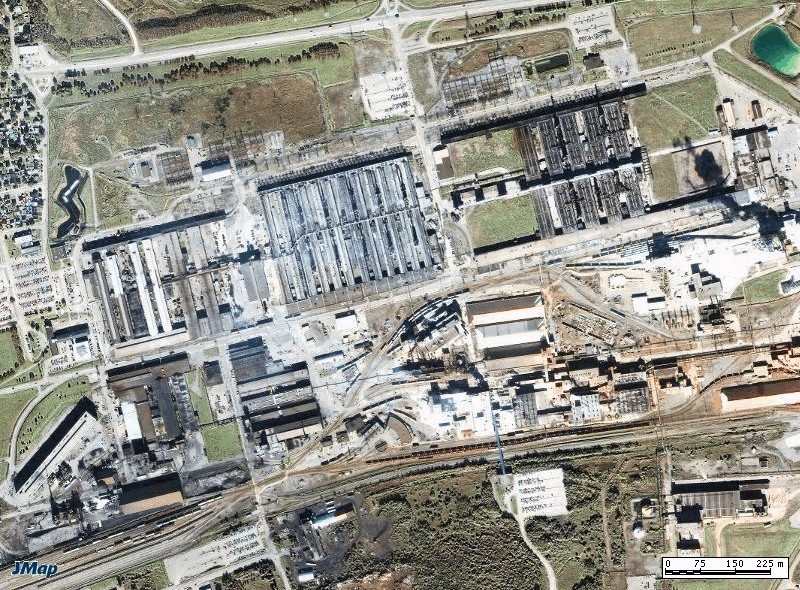

Arvida Smelter

Growing up in the shadow of industry undoubtedly had an affect on the members of the group in their formative years. The name “Voivod” refers to a character created by drummer Michel Langevin when he was 9 or 10 years old. He created not only a character, but an entire universe where the Voivod is the prototypical Outsider anti-hero. Described as a “vampire lord in a post-nuclear age” the Voivod, when looked at through the lens of humanity’s relationship with technology, is also an “everyman” of sorts. This universe, the Voivod, and the land of Morgoth would see a more tangible existence in his later years as they became the foundation for the band the would ultimately be named after the hero.


It is impossible to go into full detail of the concepts of each particular album for a few reasons: it would take thousands of words, excellent expositions on them already exist, and lastly, the concept of a particular album isn’t as important to this essay as the “big picture” the five albums present as a whole. Some background information is necessary, however, in order to understand this big picture.

Voivod’s debut succinctly titled War and Pain was released, maybe not accidentally, in 1984. The Voivod finds himself after a nuclear war. A maimed creature of flesh and bone, he and his tribe are bent of destruction. The human-ness of the Voivod is evident in his make-up and hell bent destroyers serve as chilling reminders of the technological violence of Mankind. The blistering thrash assault is fitting aural accompaniment to such a concept, and along with the lyrics and cover art, add to the ultimately “human” nature of the album.
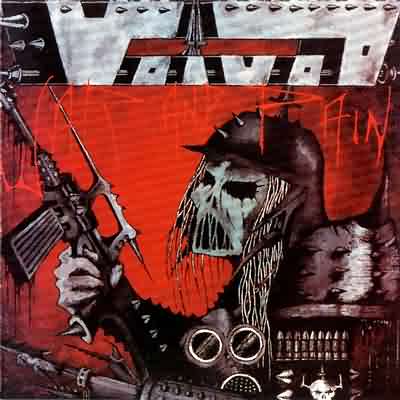


Though disfigured, the gun-wielding, Prussian helmeted Voivod has undeniably humanoid features. His anatomy his anthropomorphic and he’s carrying a gas mask signifying that, despite his supposed invincibility, he is still vulnerable like humans despite their false feeling of superiority over nature. The logo itself is a no nonsense bit of thick spiked steel, again pointing to the earthly aura: steel and spikes in this world are still effective weapons.

Two lyrical excerpts serve to highlight the Voivod’s perception of himself and his outlook on other survivors on Morgoth:

“I'm a nuclear creature
For atomic fight
Come with me in my spider line
In the black hole of the night
Your visit is short today
Don't worry in the terror you stay
And if you don't trust me
I'll chop your body to eat “
-”Voivod”

“Black flag is on my mast
The cannons creep
In your desert to kill
And no defense, no forces
You're the bloodlust victims
In the smoke of combat
No gods gives you the guts.”
-”War and Pain”

It’s important to keep in mind here that the Voivod at this point has a perception of himself as an individual. He is conscious of the fact that he is a nuclear creature, meaning a product of a technological age, and exerts dominance over other creatures through the quenching of his incessant bloodlust. Again, the use of blood keeps this album grounded in the physical, perceivable reality.

With Rrröööaaarrr...!!!, the human element begins to fade and mechinization and more developed technology begins to take control. After a series of nuclear wars, Voivod becomes a “new-age biochemical war machine” with more advanced, fearsome weaponry: Korgull the Exterminator. Korgull spends his time patrolling prisoners and exterminating those who would seek to escape. A look at the cover shows the Voivod looking more mechanical, a skinless Terminator, at the helm of the roaring machine of death. Similarly, the logo has become more “futuristic” to look more like an extension of the machine than a solid slab of metal.
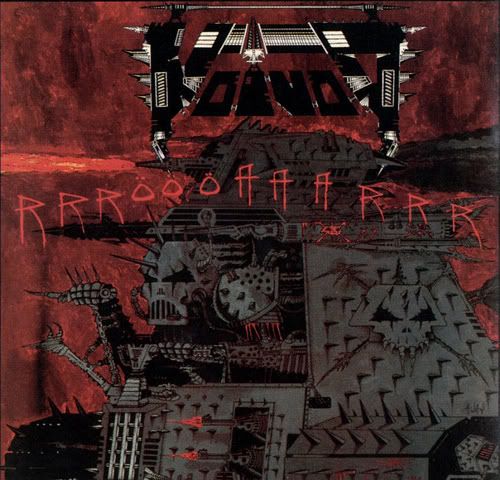


Like the cover, the lyrics have shifted into a more mechanical world; a world less under human control and more under the control of the machines they’ve constructed:

“If you need the horrors of war
See Korgull
The nebulous prowler will come to
Take you and exterminate your life “
-”Korgüll the Exterminator”

However, there is still a human element prevalent as the Voivod is still driven by the urge to kill, only this time in a more sophisticated and “progressive” fashion. Think the brutality and wanton destruction delivered by the first machine guns in World War I or the carpet bombing of World War II versus that scientific wonder of the Second World War -- the atomic bomb.

“Tonite we celebrate
War and our victory
All possessed by the death
To take the force by the blood
Raise your hands for the final slaughter
High pressure marching like
A robot from nowhere
Mutilation we're out to
Conquer all the planet
Creeping weapons see the
Fire blows the sky
Invasion don't stop the
Pressure of pain “
-”To the Death”

And so ends a chapter in the journey of the Voivod.

The middle period of Voivod begins with the more progressive Killing Technology. The Voivod is no longer a planet-roving human, he has become a space traveling cyborg/human. The transformation from human to machine is almost complete, symbolized also by the destruction of Morgoth. With this more complex story comes more complex music and lyrics to fit the new world of the Voivod. Even physically the Voivod has become more complex. His depiction on the cover shows he has completely shed any human likeness and now appears as a robotic spider/cephalopod seated at the controls of his spaceship.
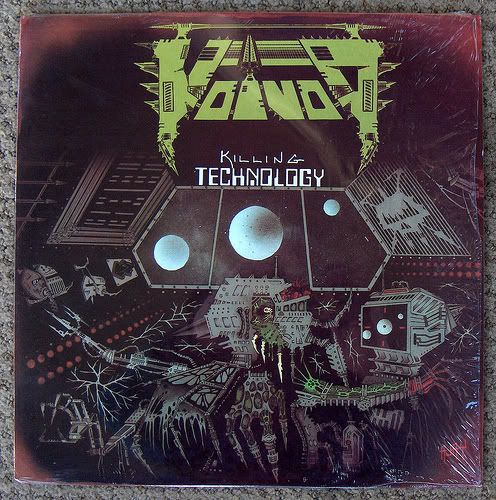


The album was released during the time of the “Star Wars” missle defense system and encroaching technological control. That Voivod (the band) felt strongly about these subjects is evident in their working it into the conceptual storyline. The lyrics show how they viewed these space weapons as an example of human’s inability to deal with/control high technology:

“This sphere is a bad place to live
Growing technology
Fooling technology
Killing technology!!!
The star wars have started up
The new invention is coming out
Making a spider web over the atmosphere
To make them sure that we can't get out of here
Computers controlling your functions
Seems like we got electronic alienation “
-”Killing Technology”

In this sense “Killing Technology” can be taken two ways: the new killing power of the Voivod (and the real world), and real life urge to stifle such dangerous technology from ensnaring the planet (note the use of the word “atmosphere” -- Voivod are aware of the consequences to the planet) and completely alienating people by taking away what little of humanity is left of them.

On a similar wavelength, the tyrannical control of the world shapers is made evident in “Forgotten in Space” and its prison ship to house those deemed hostile to the status quo:

“All systems go !!
The jailship is flying high
From the ground, to out of sight
They pay their crimes, locked inside
Where they go, the judge knows
They did to many murders
Then fell into the crater
They made too many speeches
Against what the people believe
Getting the no limit sentence
For them it's the last stop “
-”Forgotten in Space”

Whatever shred of humanity left on Killing Technology had been sufficiently dismantled by the release of Dimension Hatröss in 1988. On the cover the Voivod is nothing more than a bizarre hockey mask of a head atop a large cube. His head is open with a syringe either injecting what I’d imagine to be some sort of mind control substance or sucking out the last of his personality, making the transformation from man to machine complete.
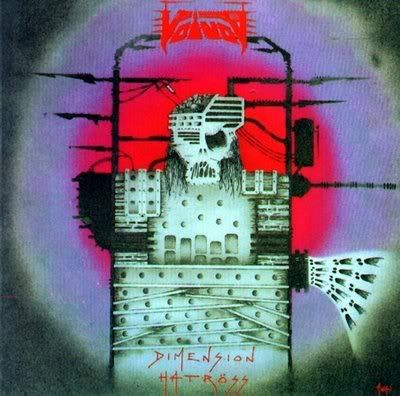


This album features this nightmarish Voivod seeking to explore another dimension. The liner notes sum up its journey: "Inside a giant particle accelerator, a beam of protons traveling at near the speed of light meets a beam of antiprotons moving equally fast in the opposite direction. The protons and mirror-image antiprotons annihilate each other, creating the fiery chaos of a parallel microgalaxy. Experiment one complete, the 'Voivod' goes into that new dimension, meeting different civilisations and psychic entities, extracting knowledge and energy in the eight programs of this project called: Dimension Hatross.”

This is an infinitely more complex undertaking than all previous releases and the lyrics and music reflect these new intergalactic boundaries. Better production makes for a more rewarding experience, allowing the listener to become fully absorbed in the odd harmonies and off-kilter, yet still relentless compositions. Piggy’s guitar work reaches new levels of dissonance stressing the alienation felt by the Voivod and those member of our own society with more active brains:

“I've passed the entry of the system
They taught me with an anthem
It seems like I'm one of them
A kind of people I can't describe
They got a number between their eyes
Identity has been commanded
Subconscious has recorded
The orders from the big head
I'm now a part of this machine
Supervised by the telescreen “
-”Technocratic Manipulators”

The Voivod has enetered a world of automatons, created and controlled by the machine. Upon leaving this new dimension to return “home” the hope of humanity returns. Speaking in the first person, the Voivod refers to his bones and soul going home, could this be one putting his faith in the saving power of technology? One who has given up? One who wants to simply exist?

“The final process
Hard and so complex
Reverse the motion
Adding some tension
Setting the machine
Awaiting to leave
My bones and my soul
On my way back home
Have a look behind
Nothing more to find....”
-”Cosmic Drama”

The answer comes with the final album in the conceptual string, 1989s Nothingface. Despite the terrible late 90s nu-metal title (which can be forgiven because a) there was no nu-metal and b) it is the perfect title for the album), Nothingface is even more introspective than Dimension.

Nothingface was released after singing a three album deal with MCA records. As a result the production is completely “pro” and the intensity is more restrained than previous albums. It is still most definitely an adventurous album, however, and the lack of intensity allowed the group to explore more subdued arrangements which complimented the more cerebral lyrics and concept of this final piece in the puzzle.

The Voivod, completely alienated from the world, retreats into the caverns of his own mind. More humanoid in appearance, the Voivod resumes his “everyman” role as a faceless, anonymous nothing. The jarring images around his empty face appear to be projections of his own mind: the hanging human, the carnival-esque birdman (alienation, Kafka’s Gregor Samsa), and a prison.
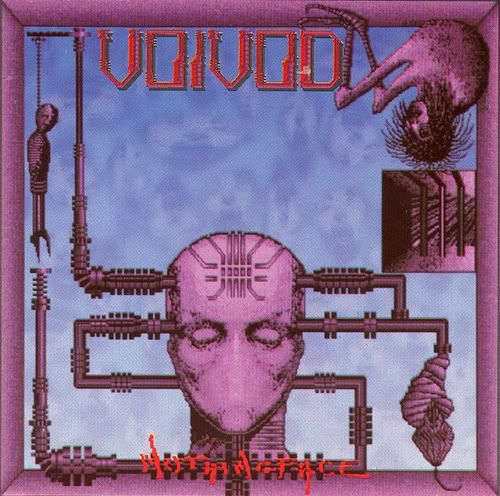


His original personality destroyed, the Voivod attempts to create others, but they all fall short. He is a completely alienated character with no shred of his original self left, hence a “Nothingface.”

“Please no
Too late for S.O.S.
Mute island, fish-eye view
Circling the border line
No resource, no rescue
I'm stranded, I'm otherwise
The error is perfect
Like this sub-effect
Of my mind...my mind”
-”Sub-Effect”

And with the closing of “Sub-Effect” so ends the Voivod. The follow-up to Nothingface was the largely underwhelming Angel Rat, which abandoned not only the Voivod concept, but also most things made Voivod Voivod. But the first five albums, especially when viewed as a whole, are truly intelligent, original, thought-provoking pieces of music that accomplishes what all great metal and art seeks to do: transcend the individual and view the world "from the outside" in order to foster a better understanding of it.

-Zach

NOTE: Excellent bios on voivodfan.com and voivod.net were used as references in the condensing of the actual conceptual storyline of the 5 albums.

Saturday, January 17, 2009

Licensed to Critique: The Fine Art of Ample Destruction

Though I should,at some point,type out a lengthy and in depth review for this pinnacle of U.S. power metal, I'll stick with my original plan for now..that being a study of the original 1984 Ironworks/Azra cover art(and cover art only). I have never been too interested in Jag Panzer's other works though the 1983 EP is a pretty solid effort. You could say it's a taste of things to come. Their resurgence never piqued my interest but I'm glad to see them writing,recording and performing. On this particularly freezing January day I'm shut tight in my bedroom looking at an 844 x 588 jpeg of the original vinyl cover art. It's a photograph and unfortunately it wasn't taken by me. No, I'm not a heavy metal LP collector though I almost always wish I could be. I've not the funds to splurge on private pressings and original NWOBHM 7"'s. I do buy vinyl but nothing that comes close to the price tag of an "Ample Destruction" original. I'm more of a "just picked up Control & Resistance or Death Or Glory" music listener. Nothing too hard to get your hands on..easy to find for around $30.00. I also like buying new/current metal vinyl releases but current metal bands that floor me in amazement are few and far between. So anyways, I'm looking at this photograph and as usual I'm a bit irked by how blurry it is but I remind myself that this is the biggest jpeg I've ever found and there isn't any wallpaper sized version to study from either. A smaller,but clearer picture of the cover is open on a tab in Firefox..I'll be inspecting this one a bit,alternating between the two. I'm not going to spend time on the pic disc version with the tank photograph on it because there isn't much to it.
When "Ample Destruction" was bootlegged throughout the 80's and reissued in 1990, this incredible cover art was never re-used. The 1985 Banzai Records bootleg presented buyers with an ugly uninspired cover,a multi-armed robot emitting weird fluids in a vague mountainous valley(?) It's very hard to understand exactly what this fucking is and I cannot find a hi-quality jpeg anywhere. It probably goes without saying that this LP/cassette art was thrown together in a rush in order to get the album out on the street. Barricade Records put out their bootleg version in 1989 and opted for a less forgettable,though equally random,cover. We've got three or four hookers in front of a bar or diner..liquor on the table,the woman standing up has a tit sticking out of her leather trench coat, and she looks rather vexed. Maybe it's the fact that she's on the cover of a crummy bootleg and there is what looks like a lighting storm approaching in the distance. Who knows..maybe she's mad at somebody for laughing at her cheap looking butterfly necklace? A biker is making his/or her way into the scene from the right and there's a digital clock in the background (up above the police hat worn by a lustful Latino vixen). Nothing about this transmits the fury of "Generally Hostile"..the burning energy of "Licensed to Kill." It completely fails at registering any type of bond with the music on the album. Maybe if you were about 13 when you sat down and took a good gander at this cover art you'd find yourself "Harder Than Steel" but that's about the only link I can find here. It's at least executed with good technique. I wonder if the art was lifted from something else?


As the year 1990 rolls around, Metalcore Records officially reissues the album and what do they do with the cover art? Why they add a THIRD horrible and embarrassing cover to the collection of course! The most lazily drawn pile of bodies is the first thing that I notice(man..these look awful!). I don't think there would be much of an argument over the quality of this drawing. It's not as if all other heavy metal cover art coming out at the time was lacking in skill. Certainly a better artist could have been acquired. The bodies of all these bald headed male corpses are bloodstained and sitting in a heap upon a rock or queer shadow of some sort. It looks like it could be a puddle..but it's a black puddle so that gives us a clue that it's not a puddle of their blood. Atop this miserably drawn mess sits a thin but muscular elf,brooding,staring at his blade,..dripping with fresh man blood. He's got a terrible hairdo but I am not going to pick on him for his individual style..rather he just looks a bit awkward overall..sitting there. In white Times New Roman font,"Ample Destruction" hovers near the bottom of the cover. The general hues are a pink/red..kind of warm and not at all striking or eye catching. This could be the worst cover in my opinion. The "but it's just a crummy bootleg!" reply is no excuse this time around. We've traveled through realms of terrible art and just now come to the end of the list. The very last alternate cover reissue is a Metal Blade reissue from 1991. Twelve shields,bearing relatively simple designs,sit 4 to a row on a grayish background. The band name above,the title below..really a bit of a fresh air compared to the last few covers. I can't say that I like it.If you were to look at it quickly it easily looks like some type of car ad. Again, this is not the least bit worthy of a package in which to house such an electrifying collection of perfectly laid out metal songs. The only upper might be how royal and dignified the cover appears..kind of falls into line with "The Reign Of The Tyrants" or the power metal ballad,"The Crucifix."


So let's get back to that original album art work now that we've covered all of the alternate reissue covers. Most likely your eyes will at first be drawn to the head of the apocalyptic riders as she's front and center. Her jet black steed seems to be aware that he's posing for your viewing pleasure as he's turned to the side and looks to be flying upwards. At this angle you can get an almost full body view of the rider..a horned,scantily clad cross between a gypsy and a geisha. Unlike her three cohorts, her face bears an expression of rage or maybe she's reveling in feeling evil? Her scimitar sword in one hand,the other looking as if it's about to cast a spell or hurl a fireball. Being a woman on an 80's metal album cover, it's no surprise that she's top heavy(ample distractions?), but she's a far cry from the big breasted temptresses and helpless slave women that adorn many records. She's got a belt of baby sized skulls which probably rattle against one another as she rides through the skies on her demonic horse. I've never once looked at this album art and felt as if she's NOT the leader of the pack..it seems obvious that she is. Behind her to the left there is a far less cool robotic knight type of character. His head/face have always bothered me a bit,looks kind of crooked. His horse appears to be fairly normal compared to the woman's and there isn't much in the way of detail going on with him..kind of a hellish automaton or something. Thankfully there's a skeleton rider galloping behind him through the air, and now that I think of it you can almost imagine both of these horses galloping in time to the drums in "Symphony Of Terror." Then again,the reaper's horse looks quite sickly and bony..kind of like a skeleton himself but while retaining the form of a full horse? Maybe it's safer to say that this particular horse just floats along,a assembly of bones and hunks of flesh animated by way of sorcery. The skeleton rider looks tremendously bad ass, with a horny helmet and scythe in hand. Obviously we can draw some parallels to the fabled four horsemen of the apocalypse here but there are a lot of inconsistencies. This menacing reaper is obviously 'death' and all the way to the right of the cover is a man on a black horse holding a balance who is undoubtedly modeled after the third horseman,famine. There is nothing particularly awesome about this character..he is holding a balance after all(and wearing a stovepipe hat) but I think he adds variety to the group..looking somewhat like a regular human being. As I noted before, there are a good amount of inconsistencies when comparing this gang to the four horsemen. Mostly on behalf of the lady who isn't riding a white horse,doesn't have a bow in sight,nor a quiver of arrows and she's certainly not wearing a crown. I guess the robotic black knight could be the rider of "war" upon his red horse waving a sword? Calling his horse red might be a bit of a stretch. It's safe to say that the artist knew about the four horsemen and used it as inspiration but they didn't seem to sacrifice the overall presentation for historical accuracy. I'm sure that you who have heard "Ample Destruction" can agree that this is the most befitting cover out of all that I've reviewed. Everything about it as a whole perfectly illustrates the music on the album. The passionate fury,the glory,the praise of battle and bravado..I could go on and on here. And look at the terrain and the sky! Doesn't look anything but American to these eyes..like a scorching hot desert now becoming slightly chilly as the sun sets. There are some shapes around that could be ruins or craggy buttes..Utah,Arizona,Mojave desert? Who knows really? An artists name(too small for me to be able to read of course)sits in the bottom right hand corner. It begins with an "A" but I've never been able to get any farther than that. All the colors of the sunset,the creamsicle oranges,baby blues and smoky grays, they compliment the dark riders and the mesa over which they fly but even better do these warm sunset colors compliment the border of the cover. A black border with red lettering, almost always a good color combination. The band name isn't too fancy but neither is it treated without any thought..it looks very classic. In what I'd call a "Terminator font" on the bottom of the album is "Ample Destruction." What a fucking clear but wonderfully worded album title. These guys really knew what they were doing here.


One can only wonder why Jag Panzer don't uphold the glory of the olden days. Try as you might you will most likely NEVER come across any old pictures of the band, definitely not by way of their website or Myspace. There is nary a quality scan of this album art and I think they oughta get on it as this is surely something to be proud of. Maybe something to type on another time. As it stands today, this album art is among my top ten favorite metal album covers of all time..in fact.......

*original art ONLY thus cancelling out (favorite)Burzum and Cirith Ungol covers
1.Iron Maiden-Powerslave:Derek Riggs
2.Judas Priest-Screaming For Vengeance:Doug Johnson
3.Fates Warning-Awaken The Guardian:Third Image
4.Jag Panzer-Ample Destruction:????
5.Emperor-In the Nightside Eclipse:"Necrolord"Kristian Wåhlin
6.Saint Vitus-Mournful Cries:Lionel Baker
7.Ved Buens Ende-Written In Waters(original):Lise Myhre
8.Black Hole-Land Of Mystery:????
9.Black Sabbath-self titled:Marcus Keef
10.Voivod-Killing Technology:Michel "Away" Langevin

-Matt

Friday, January 2, 2009

Physical and Mental Landscapes

Herein lies a short review that seemed to take me forever to complete. A review of Skepticism's monolithic "Stormcrowfleet." I am mostly satisfied with it though I was hoping to return to the state forest and think it all through before wrapping it up. Due to nearly every other day being wet(rain or snow)I haven't gotten over there. I've also been feeling like hammered shit lately thanks to catching some bastard form of a cold from my recently departed friends(not departed as in 'dead' but departed as in 'moved overseas'). Today is the first day since Monday that I haven't awakened dizzy with a headache but my throat seems to be worse. Time to get some more Airborne placebo medicine and/or hit the bottles. Since I felt a bit quicker in mind it seemed like a good idea to finish this review. I seem to get a once a month inspiration fever in which I have a dozen ideas for this blog. I run with one and inspiration turns to procrastination and you know the rest. Anyways, without further bullshit.....


Red Stream,1995
Line-up :
Matti - Vocals
Jani Kekarainen - Guitar
Eero Pöyry - Keys
Lasse Pelkonen - Drums

I sauntered on down the dirt road and looked for the first small path on the left. The cold was taking it's toll on my ungloved hands and my nose was running. Choice weather for a walk in an undamaged and vastly unexplored forest...well if you're me, which you aren't. The dubbed cassette copy of "Stormcrowfleet" fit unsurprisingly well with the stark, naked trees,crumpled leaves and blue sky. Yeah, blue sky..no requirements for a gloomy storm front moving in(though that would have worked well too). Skepticism play what those labeling-happy types might call "atmospheric funeral doom." Funeral doom seems to be mainly about mourning, loss, death, and despair, all set to slow pounding drums and drawn out sequences of simple riffs. Death metal type growls usually dominate the mic though some singers add variety with clean vocals. Female vocals are rather commonplace. All of this sound rather boring? Well yeah, after hearing many of the "amazing classics" that the sub-genre has to offer..I arrived at that exact conclusion. However there are exceptions. Bands that have sought to make music before making a name for themselves in whatever their choice of sub-genre might be.

Two summers ago I was killing time, on the prowl for a job in sweltering Austin,Texas. I spent a lot of time surfing the net at a little bistro, just crawling with the exact type of 20 somethings that you might imagine. While browsing the web for jobs I maintained a strict headphones at all times policy..sat off in this one corner. I quickly found that Skepticism's debut album tended to calm me down, decrease the rage and anger that I had towards the present situation and all the while inspiring my imagination to beautiful landscapes, oaken sheds far off in the woods, mist filled chasms, snowcapped mountains, a crisp winter sunset overlooking a clearing, humming fields of cicadas on a windy summer night. I'd begin to wait until getting back to my friend's apartment and listen to the album alone in the coolness of the unlit livingroom. With the cavernous vocals very muffled due to the production, the low end growl transmitted no clear words into my mind. This allowed for me to very easily focus all my attention on the whole. Painfully slow melodies, the structures of the songs and the simplistic time keeping aspect of the drumming. Deep guitars rumble alongside bass guitar and organ, all very bass drenched and earthy sounding. What uptempo melodies there are either come about by way of organ/keyboard, weaving their way over slowly drawn out chord progressions or by guitar, usually a faster moving part layered beneath the heavy plodding of the other instruments. You'll tend to notice little variations on the main theme overlaid for variation and helpful in heightening the atmosphere. Paying careful attention to the drumming performance I've come to realize how the slow marching pounding of the toms, with expressive but minimal cymbal work, sounds very shamanistic and primitive. Instead of utilizing all of the space in between snare or cymbal hits with fills, the drummer keeps it simple and channels all his force into every building pound or crash. A protracted march through rugged terrain. It's not difficult to sit back and relax, allowing the music to work as extremely heavy oil paints, manifesting nature oriented imagery on the canvas of your mind. I never found "Stormcrowfleet" to be depressing or full of melancholy and woe..it's uplifting. It seems as if Skepticism took a good deal of their inspiration from soundtrack music and ambient..there aren't any real metal-by-the-numbers moments to be found on this record. The spirit of metal is alive and well but in a very raw and simplistic form, maybe yet to be mined out of a mountainside. If you are looking for traces of death metal or doom metal(in it's pure state)..you won't have any real luck in finding it here.
Now I have to bring up another band credited for birthing the sub-genre of funeral doom, Thergothon. I think of Thergothon and Skepticism as being brothers. Both Finnish, both active/around at the same time, both playing a crushingly heavy and ambling style of highly atmospheric metal. I can't help but feel that both bands were trying to create the most ancient, rustic and mysterious sounding slo-motion metal record. Thergothon's "Stream From the Heavens" isn't half as magical as Skepticism's debut but it trudges along at the same pace, sad but triumphant hymn-like songs with growling vocals, inspiring evocative imagery in the mind of the listener. Thergothon tended to base their lyrics around Lovecraftian mythos and were perhaps a bit more sinister in terms of their riff writing, so..to these ears it sounds a bit closer to extreme metal than Skepticism. The production on their full-length turns me off as it's a lot of distorted highs, crispy fried keyboard and unfortunately weak sounding drums. I roped them into the review because I believe that they were also trying to kind of go beyond metal..rather than speeding it up to a blistering pace, they slowed it down..waaaaaaay down. But more importantly, both albums can be listened to much like ambient music. It's not merely slowed down death or black metal a la Goatlord or Argentum..but striving to be something more. While Thergothon reach for the cold mysteries of the cosmos, Skepticism crawl beneath the earth and trudge above it. This earthy quality charmed me from the get go, it's warm and comfortable, somehow familiar. I sometimes wonder what my reaction would have been to this album back when it first came out. I was very young at the time and knew little to nothing of guitar-based music. Yet, I feel as if younger me would have latched onto this. My overactive imagination, love for the outdoors, the autumn and fantasy worlds would have worked well with this dreamy metal. Perhaps because I predominantely listened to soundtracks and classical music back then and as I already stated, this sounds very soundtrack inspired in a way.

Lyrically Skepticism only solidify my views on their music. Rather than petty prose based around broken hearts or self loathing we get these;

On the cold bridge of grey stones
Stood the old man in his grey robe
Opening his oak barrels
Pouring them to the river


---------------------------------------------

The forest is around me
In silence the pines stand tall
With the wind they whisper their tales
As their wisdom is everdarkgreen


Very simplistic and almost haiku-like when you read them.

When I started this review I was writing about walking in the forest and I want to get back to that. I believe I was listening to "The Everdarkgreen" when I ascended out of the woods and came upon a vast clearing of low cut brush and some short dead trees. A twisted, frost encrusted club(well I quickly imagined it to be a club)was lying in my path and naturally I picked it up and swung it around like a weapon. I walked onward with it in my hand and let my mind do some quick plotting..if I was a type of scout, no wait, a type of goblin scout, roaming the borderlands of goblin territory.The music added such mystery to the long unexplored path and I walked slowly enjoying every step, enjoying every sidestep or hop over a mud puddle, not scurrying around while repeatedly checking my cellphone for the time. "Stormcrowfleet" works as great calming, meditative music. Maybe like a metallic Steve Roach. A breeze through the pines and a powerful gust of wind from off of the cold ocean. Skepticism creates a world within your imagination or turns the real world surrounding you into some far off planet or buried and forgotten kingdom. Most thought out heavy metal in general, or the heavy metal that I hold in highest regard, does this exact same thing. It's in the creation of an out of this world setting by way of guitar tone, melody, vocals, production, instrumentation(conjuring)..the manipulation of setting by wisely wielded and genuine power. Power to reshape and remake or to wholly remove the listener from reality. This is why I personally prefer Mercyful Fate over Venom, Voivod over Anthrax, Sacramentum over Marduk and Demilich over Death. That's a topic for another time('magick metal':).

http://www.skepticism.fi
http://www.myspace.com/officialskepticism
-Matt

Tuesday, December 16, 2008

So Pure...So Cold: Transilivanian Hunger as an Embodiment of the Faustian Spirit

If only one word could be used to describe Darkthrone's 1994 release it would be minimal. That can be misleading to some, conjuring thoughts of mindless simplicity or uninspired drivel. In actuality, the minimalistic nature of Transilvanian Hunger - with its swirling vortex of repetitive, trance-like riffs and static percussion - accomplishes something few modern albums have: it captures the infinite space of the Western, or Faustian spirit.

In Decline of the West, philosopher Oswald Spengler, describes what he calls the Faustian soul and its development around 1000 AD when Western Man confronted and gained knowledge of Death - when the idea of an impending end of the world spread throughout Europe. The Faustian, or Western, soul in contrasted with that of the Classical, or Apollinian. Classical man regarded as the prime problem of being: "the material origin and foundation of all sensuously perceptible things." Reality, however, exists beyond this tangible plan, as he explains further: "The prime symbol of the Classical soul is the material and individual body, that of the Western pure infinite space."


For example, he cites Apollinian cosmology as well-ordered and ending in a quantifiable "heaven," which is reflected in the grounded columns of Classical architecture. Compare this with the soaring buttresses and magnificent facades of Gothic cathedrals. Faustian art, such as a landscape of Claude Lorrain (one of Spengler's favorite examples), is pure space. Spengler describes this space: "Space - speaking now in the Faustian idiom - is a spiritual something, rigidly indistinct from the momentary space-present, which could not be represented in an Apollinian language, whether Greek or Latin."

Language, mathematics, science, and art allowed the Faustian man to contemplate and develop ideas in relation to the concept of space, a chaotic universe, and wild nature. Spengler goes much more in depth and discusses the origins and importance of this space in great detail, which warrants an essay or book of its own. However, that is not meant to be the crux of this essay. This is an essay about music, something uniquely adept at capturing space: besides Lorrain and architecture, Spengler also uses music as an example of it in the Faustian world: "It [18th century instrumental music] is the only one of the arts whose form-world is inwardly related to the contemplative vision of pure space."
He refers particularly to the music Ludwig van Beethoven: "Here infinite solitude is felt as the home of the Faustian soul. Siegfried, Parzival, Tristan, Hamlet, Faust, are the loneliest heroes in all the cultures." The music of Darkthrone, like Beethoven (though on a lesser scale, and vastly inferior to the great master) embodies this solitude, contemplation, and ponderous awakening.

In Matt's last essay he talked about the "Metal Ear," an ear which applies to any intelligent music. When I first heard Darkthrone I didn't have this ear and I heard the Preparing for War compilation. As a result, my initial reaction to Darkthrone was not of the positive nature. I didn't dislike it, but I certainly didn't like it. Looking back, I think it was because I didn't understand it. Armed with a lukewarm appreciation of metal and a thoroughly unfocused musical attention span, I attempted to listen to Darkthrone. I had heard and enjoyed Emperor and other extreme metal years before, so extremity wasn't the issue. Darkthrone is different, it is extreme, yes, but also extremely minimal - adding a layer of difficulty.

After putting Preparing for War on the shelf for almost a year, I decided to give Darkthrone another shot. I had begun listening to more and more metal, and a lot of it extreme. The more I read about it, the more I felt it deserved a second chance, something I was bad about up until a few years ago: I'd hear something once or twice, make a snap judgement and ignore it. Why else would it have taken almost five years of serious interest in metal to get over a ten year aversion to Deicide (based on one listen in a record store in middle school) and listen to Legion?

I bought Transilvanian Hunger for a couple of reasons: the reviews seemed interesting, I liked the title track from the compilation, and it was the only one in the store at the time. I slowly began warming up to it, and my appreciation for its beauty grew as my metal ear developed and as I began taking a more thinking man's approach to music in general.

Transilvanian Hunger reflects the infinite space of Spengler's Faustian soul even before the music starts, as the inner sleeve art features a blazing full moon above a thick forest and the almost encapsulating arms of mountainsides. The mountains do not, and cannot enclose the sky, and the breadth of the night sky in triumphant.

The triumph of infinity is solidified when the music commences. The opening track is the aforementioned title track. The percussion, Fenriz stripped down to a human metronome, serves as a backbone for the boiling, simplistic riffs. The initial/primary riff is arguably the best example of this. The "space" embodied in Transilvanian Hunger derives mainly from the trance-like repetition of 2 to 4 note patterns, while tremolo picking and vacuum guitar sound make it even more all-encompassing.

There is also something so utterly European and medieval in the album's title, which conjures images of mountainous expanse, endless horizon, and cold castle walls. "Over Fjell Og Gjennom Torner" captures this feeling as the muffled, spoken, throaty vocals set a frightening atmosphere - suited to the vastness of Northern forests.

A personal favorite, and a track especially expressing space, is "I En Hall Med Flesk Og Mjød." The repetition of a SINGLE NOTE for an extended period truly creates a whorling infinity. The listener becomes enscrolled in it just in time for a more aggressive passage, which gives way to cloaking repetition yet again. It is thinking music that requires full attention to comprehend the beauty, power, and art in its simplicity.

It is possible for Darkthrone to create this space because the music is not rhythm driven. It has a rhythmic backbone, but, like the instrumental music of the 18th century so acclaimed by Spengler, is driven by stringed instruments - in this case the melody-assault of the guitars. "Slottet I Det Fjerne" features a particularly piercing high-end thanks to Fenriz' (according to Metal Archives) furious guitar playing.

In Transilvanian Hunger, Darkthrone has created an intelligent work of art that, as Spengler says of 18th century music "contemplates the vision of pure space." This space is so important because it is a representation of humans thinking in more abstract terms and of the complexities of a chaotic, infinite universe.

-Zach

Thursday, October 23, 2008

Metal for One Please


I was staring out the bathroom window today, taking notice of the tree across the street. Autumn seems to be so gradual at first as if it might never arrive but then before you know it you find yourself staring at a blazing orange and gold tree in your neighbor's yard and wearing a flannel shirt nearly every day. It's been month's since I've written anything in full. I have a bad habit of starting a review or an essay on an enthusiastic whim and days later I'm four paragraphs in and stumped. I could easily blame it on the ever flowing stream of thoughts that run through my mind resulting in a failure to focus. I guess I could also blame it on current events,depression,laziness,the list could go on. Plainly spoken,it's been a general lack of good content that's to blame. When it comes to reviews I could spout my personal reasons for liking such and such an album any old time but I intend on making each review above average. If I find myself just repeating a lot of what's already been written elsewhere I end up being frustrated and tend to watch the cursor blink persistently on notepad while daydreaming. It would be easy to sit on the computer all day,fantasizing,reading,peeking in on various forum threads, but I grow restless and want to make use of my time. If writer's block manifests itself then I had better move along to the next project while it's still early. Since I haven't been working my part time money gathering job I've been painting,practicing guitar and trying to gain some ground battling my constant overworked brain through meditation. Early last Thursday morning(after 12:30 sometime)I captured a fleeting moment of thoughtlessness. I had no sense of sitting cross legged in the dark living room but rather felt as if I were floating in a swirling void. Being the meditation novice that I am, I registered the "I DID IT!" thought and that sent my mind back into normal mode,out of any such void,back into the living room,back to anticipating the cuckoo clock cuckooing and I then remembered that it was nearly 1 am. This speck of time was the highlight of last week. I'm glad I am able to comfortably experiment like that. Glad I spend around 85% of my time with my brain and myself. It's throughout my daily "routine"(or at least my daily unemployed routine)that I THINK about THINKING or analyze and plan actions..and of recently I try to just "BE" at least once a day. I have grown so used to this living style that I would be easily annoyed or even hostile if I had someone else constantly buzzing around and intruding on my thoughts and time. Sounds a bit extreme if you're a social extrovert but I have developed a lot as a person under conditions of maximum alone time. Often I come to realizations about important things by myself and it's hard to communicate them to friends or family a week later. An element which has aided me in contemplation and been my companion throughout is heavy metal(grave metallum:the music of the gods)

*Metal,most notably the extreme cast of metal,is most rewarding when listened to in solitude. The live show while being an intense and moving aural and visual experience is..an experience..a social "bonding" moment for some. However, surrendering your undivided attention to a full album in a relaxed state of mind yields far greater appreciation and understanding.

I have never been a mingling,chit chat type of human being. I'd moved around a lot in my childhood years which made long lasting friendships pretty hard to keep. Once I was in my late teens, and settled down, I had broken out of my shell somewhat and had best friends,friends and those unsure types(I called them school friends).
Life was nearly DEFINED by a group of people at one point which resulted in a lot of temporary happiness but foolish infighting and easily damaged egos(a lot of low self esteem) often resulted in self hatred. I felt like a goofball most of the time. Downsizing that group of friends of lesser known friends and acquaintances was a good move but so much of me was still based around other people. When I moved out west more circles of "friends" came around. I'd smashed through the small town prison walls and entered the BIG CITY to find exactly what you'd expect. Loose attention whores,greasy hipster types who bummed off of rich college brats,artists and "musicians" out to kiss ass and gain notoriety. Feeling at odds with this majority, I steadily spent more time alone and my friends spent more time involved in their new lives. Towards the end of my Texas stint I was home by myself almost every day. This was the first time in a long time that I'd truly been left alone..and I wasn't fully dependent on friends. Tiring pop/rock songs made me sad as they typically discourage solitude. When one is alone so often and not used to it they usually become lonely..and loneliness results in pity partying and depression. Therefore many people fear solitude(and find hermits to be batshit crazy). I had bouts of depression stemming from loneliness,"nobody wants me" syndrome and poor self image issues..the lack of peers around to validate my existence and importance was hard to get used to. Moving back to the previously rejected small town intensified all of those issues.
My relationship with metal was very fickle before entering this slow zone. I was previously in search of adventure and instant gratification and would hardly ever sit and contemplate life or reality. Most of what I listened to acted in the same way..those old familiar chord progressions and accessible melodies that easily trigger basic emotions..acting as instant gratification in a sense. Music you needn't really hold a magnifying glass up to because it's whole shtick is being simple and easy to tap your foot to. Pop and rock call out to the lonely individual by predictably tugging the usual heartstrings,"I feel your pain","I'm so lonely too man..I gotta find myself some action."At their worst they act as a soundtrack for the lives of the masses who weep over sappy songs and schmaltzy ballads or feel uplifted by one dimensional "I"m gonna make it" songs. Pop and rock weren't complimenting my life but rather depressing it. What worked well in a group setting failed miserably when listened to in my chilly upstairs bedroom back home.

Metal seems tailor made for one,that so called loneliest number. A rebellious spirit fighting against the world,never giving up,encouraging and genuinely empowering the dedicated listener. It's almost a beacon for loners. To enter the realms of extreme metal and gain transcendence one must first develop an ear. It's hard to do so at first but little by little you will "get it." The best metal requires much listening,ear developing, and thinking..something that cannot properly be done with lots of people around yapping it up. Many people will talk about how much they understand death and black metal without ever having really sat down and listened to full albums. It's usually easy to identify hipster parasites within metal because they are all about the shuffle feature. Listening to a mix match of random black,death and "doom" metal tracks on your ipod while sitting in Starbucks,spending about 10 minutes talking on your cellphone or LOL'ing with a bunch of people online..this is not the way one listens to and appreciates extreme metal. I suppose if you are listening to a bunch of mediocre SHIT then it might serve you well to listen to it in shuffle format while not fully concentrating upon it. Don't get me wrong here..a good mixtape is nice to have around and sometimes you might be in the mood to hear just one particular tune...but nothing beats a good quality album from start to finish. Deep and intermediate listening separates the wheat from the chaff so to speak. There is little room for mediocrity in vinyl,cassette,cd or mp3 collections when you are listening in a full sitting with a critical ear. That 46 song pornogrind cd doesn't sound so good now does it? But so many will enjoy metal as a hobby or a social networking tool. This greatly depreciates the power of metal and lowers it to radio rock standards..it becomes nothing but background noise or strings of songs that stick in your head and remind you of certain people or situations. A lot of common folk don't take metal seriously because they don't seriously listen to it. I recall the days of sitting in the family living room at the slow PC around 2004/2005..particularly one time,hunched over the speakers and listening to a track from Immortal's "Full Moon Mysticism." Just giving it a try..only one song you know? To these ears then it was basically noise ..I picked out some notes under the Orc-like vocals and tinny "thwack thwack thwack" of the snare drum but didn't care to focus any real attention on it because it didn't appeal to my brain on instant. Of course it didn't help that I seldom had any peace and quiet or time to stretch my mind. After simplifying my life situation and living conditions years later I was able to focus in on such well known extreme metal classics and was knocked head over heels by their sheer power and ability to really stimulate my mind on a higher level. I was soon able to hear past the common butchered production jobs and Darkthronian recording techniques..grasping the essence with enthusiasm.

Besides reaping the aural benefits of extreme metal listening,I also became turned on to a lot of previously ignored literature and philosophy. I might have had a keen interest in outer space beforehand..an overload of extreme metal listening enhanced it. Realizing you are but a microscopic fragment of dust in the universe is vital,as is realizing the inevitability of your death. Death metal(most notably the more evolved and advanced of it's kind)was a powerful tool in terms of death contemplation. Thinking of death as less of an enemy and as more of an ever present fog that drifts behind each of us..it may envelop some suddenly but it gradually covers and devours us all..and no biological organism shall escape it. I find it healthy to fixate my mind on death often as it's fascinating and seldom thought about in a rational way. How to imagine the actual end of YOU,snuffed out and no longer anything? Quite a difficult thought to ponder because I,like you and everyone else,have only existed being conscious and cannot imagine otherwise(not that anything exists after death). People tend to deny themselves such thoughts especially when they are alone. Death is pushed to the attic of the mind or covered up with the comfort blanket of religion. I enjoy talking about these things with close friends but it's of utmost importance to arrive at such ideas on your own since we can all be our own masters. Life is rich thinking material too of course,no need to zoom in solely on death. Even the most basic pioneering metal acts championed the individual and the glory in living life to the fullest by your own set of rules. Inspiring introspection. So in short,metal got my mind working a lot more and gave me a lot of self confidence in thinking and in being. Not self confidence stemming from compliments of friends,girlfriends,family members,co-workers but self confidence originating inside..awakening to aspects of myself that had gone unnoticed or been unappreciated. Perhaps extreme metal won't spark the same fire inside of everyone. For those with naturally non-metal ears I suggest classical music or some traditional folk.

-Matt

Saturday, October 18, 2008

Extreme Metal - The Exercise of a Thinking Mind

Finally.

This essay has been germinating since April and I’ve finally gotten around to typing it. I decided to compile these thoughts into an essay on one of the first truly hot days this spring while trudging through the cement jungle of Boston on my way to a favorite record haunt. Listening to a tape I have for such situations I started thinking about my distaste of heat, how that’s related to my personal philosophies, and how it boosts my already substantial intake of extreme metal.

Besides being uncomfortable, I’m bombarded by more people doing more things I dislike. Spring brings blooming and celebrating a rebirth in the natural world, but it also brings families crowding the sidewalks, loud children covered in ice cream, people flopping around in oversized sunglasses obnoxiously proclaiming their love for the “great weather,” and artificial or deliberate suntans to name a few. These things may seem trivial, but they are a reflection of things in direct opposition to all I hold dear. As a result, I’m more hostile which is reflected in the heavier rotation of extreme metal. The heat and humidity of summer are ever-present dislikes from which there is no escape, which makes other, more serious distastes, only more bitter.

Bitterness towards what exactly? There are a lot of things about the current state of humanity that make me squeamish, but for the most part all of them are a product/element of the following three things: the herd mentality of the populace, the double-edged sword of monotheistic morality dominating the West, and humanity’s destruction of its only home. These interrelated attacks on the human mind are the primary causes and targets of my aggression.

The general sheepdom of the populace is evident in the physical and mental laziness of a large segment of it. Poor eating habits, lack of exercise, and either the inability to or desire not to think make people easy targets for control. For the most part it is not the inability to think, but fear and the lack of want or knowledge on how to think. The human mind, as exemplified by the great thoughts, music, and artistic creations of humans throughout history, is capable of great things. The minds of many intelligent are dormant and have been for too long. Not all minds have the ability to create something as majestic as Beethoven’s 2nd Symphony, but most have the potential to think.

A dormant mind makes it easy to consume food that is nutritionally lacking, culture lacking substance, the blatant lies of politicians, the existence and omnipotence of a supreme anthropomorphic desert deity, and to accept all of these as fundamental truths. Many people question, but never break away from the necessity and security of belief in god or the Democratic and Republican parties. The human brain is a complex thing with the ability to process and reflect; to not exercise the brain is to not live up to our potential as human beings.

One of the biggest culprit in the enslaving of the mind has been monotheism, in the form of Judeo-Christianity in the West. The doctrines and morality of monotheism comprise a sword with two equally sharp edges. On the one hand there is the preaching of humility and unending submission, which when compounded with the sense of entitlement felt by the practitioners and products of monotheism on the opposing edge, is a recipe for cerebral inactivity and herd mentality.

According the Judeo-Christian bible, human beings were created by a supreme god in the image of said supreme god, therefore they must live in eternal fear, guilt, and submission to their creator. This vile bastard of a creator demands unquestioned obedience, which discourages thinking. Free thought and the expansion of personal knowledge is either a) blasphemous or b) impossible because humans can never truly know all that god does. There are many people who still follow this path openly, yet there are many lackluster believers and nonbelievers alike who similarly don’t think because the anti-intellectual ideology of Judeo-Christianity has been force-fed to their ancestors for centuries. This stifling of thought and uniqueness has been exhibited in many ways over the past 2000 years in the West in the burning of pagan libraries, the destruction of heathen shrines and co-opting of festivals, the Inquisition and witch trials, censorship of scientific and artistic ideas not inline with doctrine, and in the creation of a global uniculture which has largely replaced genuine local cultures. Those who have accomplished great feats of art, literature, philosophy, etc have done so in spite of this: those with the ability and passion to rise above an intellectually bankrupt order. Monotheism greatly aided in the destruction of unique human culture around the world by spreading its agenda via crusades, colonization, and missionaries. Not only has this happened, it has been championed by the very people who’s culture is being destroyed!

While the tradition of monotheism has played a significant role in suffocating intellectual freedom and creating a culture of laziness, it has also put the notion of entitlement into the heads of said lazy populace. Being created specially by god as the only intelligent beings on the only planet, which is of course the center of the universe, has created a false superiority complex in humans. If one believes they are specially created and that they are the pinnacle of all creation, it makes sense they should feel the planet has been created for them and is theirs to use and abuse as they see fit. Created as a separate entity, Man not only has the ability, but the duty, to dominate his surroundings, the planet, and other species (including segments of his own).

As the divinely appointed stewards of Earth, humans have pillaged and destroyed the only home they’ve ever known. For the believer it doesn’t matter because this life is temporary and there is eternity in heaven, but for the secular and less serious religious folk its the feeling of control embedded by the same monotheism that perpetuates the destruction, even in the face of impending doom. It isn’t the use of the natural world by Man that is the problem, but the abuse. Human beings are animals, and all animals must use their environment to suit their fundamental needs. Humans have gone above and beyond the fundamental needs of food, shelter, resources and have been driven by greed. Exploiting more resources means gaining more paper. More paper means more things. More things means more status and happiness.

The core issue is that for centuries the majority of the populace in the West, largely due to monotheism, have viewed themselves as “above the law” when it comes to the natural world. They do not view themselves as part of the animal kingdom and a strand (albeit the only known one with the ability for complex thought) in the web of life, but as being separate from the entire web itself. Massive discoveries have rocked the collective mind of humans; from learning that they are not the center of the solar system, that in fact there are billions of solar systems in billions of galaxies and possibly more than one universe, to learning the complexities of evolution, yet many still retain the “I am the center of the universe” complex, which makes destruction and mental inaction inevitable. A strong sense of self and individual autonomy is important, and I take pride in my own individuality, but do so without losing sight of that fact that I am a part of the whole of nature and a community, not a whole in and of myself. Only upon understanding this was I then able to embark on a quest for personal betterment.

Now how is metal related to any of this? Metal in general is a big “fuck you” to mainstream modern society and makes a conscious effort at separating from it. The music is loud, fast, and harsh; lyrics deal with “touchy” subjects; songs break away from the cyclical structure of popular forms; and similarly, many adherents purposely set themselves apart by their appearance.

Interest in metal begins with disenchantment, and some use that to strengthen themselves in the face of the society they are at odds with. Given that this essay is supposed to deal with extreme metal, I will limit the discussion to death and black metal. I don’t plan to write an illuminating study of extreme metal because plenty of those exist and that’s not my intention. My purpose is to explain the appeal and importance of extreme metal to me, what I get from it, and how it relates to the “bigger picture.”

Death metal is more than lax disaffection administered through an ugly wall of sound - it is the exercise of a thinking mind. It’s easy for the average humanoid to dismiss metal, especially extreme metal, as “just noise” but it is anything but. Death metal recognizes the decay, falsity, and inherent emptiness in modern society and embraces the inevitability of death, destruction, famine, etc., thus rejecting it [society] wholeheartedly. Instead of being angered, reverting to fatalism or altruism, death metal constructs music that is brutal, violent, and ugly but also complex, intelligent, and beautiful.

The term “death metal” applies to a wide range of music, and the genre is one the most expansive in metal. Whether it be the technical innovation and fusion of Atheist, the off-kilter rhythms and inhuman vocals of Demilich, or the blasting assault of Immolation, death metal (in it’s true and unadulterated form) is unified in expanding beyond the confines of popular music and a culture of stagnancy.

The first step is detachment, which death metal achieves. From the embracing of decay and negation of the mainstream it is then necessary to secure an existence amidst the surge of consumerism and whittling away of human uniqueness. Black metal uses this detachment as the foundation for rediscovering connections with nature, culture, past musical achievements and the strength and will of a healthy human spirit striving for personal betterment. If death metal is a fist in the face of society, black metal is the foot that holds it down allowing the mind to flourish. Black metal embraces and glorifies the power and beauty of the natural world and Man’s undeniable connection to it and to the past.

Death and black metal appeal to my disaffection with the above mentioned “big three” and my constant strive toward personal betterment. Extreme metal, and all of the music I like, stimulates my artistic pursuits, musical knowledge, and is an exercise in appreciation by an intelligent human mind.

Forging an existence in a world beyond my control is not easy because, ultimately, it is just that - beyond my control. That does not mean I should give up and become a zombified dimwit, but that I should try my damnedest to improve my physical and mental health to better cope with the world, to be as prepared as possible for whatever it should throw at me, and to not forfeit my potential as a human being with a working mind. By making healthy living choices, expanding knowledge through reading and engaging in stimulating conversation, physical activity, and artistic endeavors I can better relate to and appreciate my surroundings and the people I care about while hoping and working for a healthier future. I don’t know if I will ever experience a fully transcendent moment or see bonds of Judeo-Christian morality broken in my lifetime, but I will never stop working for personal betterment because I respect myself, my origins, and my sometimes overactive brain.

DISCLAIMER: I do not hold any value, philosophy, or ideal that I do because of the music I listen to - I listen to it because of the ideals I hold. Furthermore, I refer to authentic extreme heavy metal - absolutely NOT to trend-ridden, herd-appealing iPod diet metal.

-Zach

Thursday, June 19, 2008

A Destination Unknown

It's been a long time coming, but here it is...

REVIEW:

Kebnekajse - Resa mot okänt mål, 1971


Personnel:

Gunnar Andersson - Chorus
Pelle Ekman - Drums
Mats Glenngård - Chorus
Kenny Håkansson - Guitar, Vocals
Pelle Lindström - Chorus
Bella Linnarson - Bass
Tomas Netzler - Chorus
Rolf Scherrer - Guitar

Where on earth do I begin to describe this album? I suppose I'll start somewhere near the beginning. Resa mot okänt mål (roughly translating to "A Journey to a Destination Unknown") was the first Kebnekajse record I owned, which is fitting seeing as it's their first.

Named after the tallest mountain in Sweden, Kebnekajse had its roots in the seminal Mecki Mark Men, which Kenny, Bella, and Pelle were three fourths of. The Men played a more English-styled psych rock with heavy doses of organ and Cream - an influence clearly evident, though a bit more subtle, on Resa mot okänt mål. This more than adequate first album has been described as straddling a no-man's land, so to speak, with one foot firmly rooted in the psych rock of Mecki Mark Men while the other is searching for a foothold in the more adventurous and progressive avenue of later Kebnekajse output. Later albums ventured from this hybrid, to prog folk, jazz rock, and African music. I have the first three: RMOM, II, III (the latter two being excellent progressive folk albums), and in the three or so years since I've had them, the first has remained the best.

The album is striking before it even starts: the electric, undeniably psychedelic cover art immediately grabbed my attention. The colors are crisp and the concept simple. Most importantly, it is psychedelic without the usual trappings (kaleidoscopic imagery, neon colors, flowers, etc). The music contained in this artful package continues to hold my attention for the full 39 minutes, that's the important thing.

"Tänk livet" opens with a trademark of Swedish psychedelia - quite possibly the warmest guitar sound put to tape. Warm doesn't do justice to a sound that can be both dissonant and affectionately warm, while at the same time forcing a smile of tranquility lasting the length of the album. Not a particularly "special" song in the way of breaking any new ground, it's like the cover in that you know it's psychedelic, but there is something separating in from, say, The Pretty Things. In my own closeted world of the Northeastern United States, I'd have to say the immediate thing setting it apart was the vocals/song titles. Being Swedish, they added an exotic aura to a style of music previously dominated in my record collection by Anglo or US groups (or continental groups singing in English).

Besides things like the album cover and whatever exoticism (whether real or purposely created), it's the music itself that strikes me as a little "off." Not in a negative sense, but in the same way the Cirith Ungol or Manilla Road transcend the standard fare of heavy metal, so Kebnekajse transcends the standard psychedelic fare. This, without question, makes it more appealing to me and my own outsider personality. I like a lot of psychedelia, and even more metal, but it's the bizarre ones that stand out and warrant "top album" nominations. Resa mot okänt mål is one of those albums. The opener is just so damn catchy, and Håkansson's extended solo gets my head in a hypnotic trance, setting the mood and preparing my mind for the rest of the album.

"Orientens Express" features even more whirlpool guitars over a rhythm that's a cross between blues and a weird railroad worker polka or something. This lighter track is a fitting introduction to the title track, definitely the darkest on the album...probably the only one I'd use the term "dark" in describing. It has a subtle heaviness, especially in the rhythm guitar and how it plays off the lead. The last couple of minutes of the 7+ track are the highlight for me, featuring a steady, yet at the same time frantic rhythm section. For some reason, I don't even find myself hating the truly fucked up Alvin and the Chipmunk vocals on display throughout. They only serve to add to the already established quirkiness of the album.

In "Förberedelser till fest" you have what is, quite possibly, one of my favorite songs of all time. At different junctures it's everything from surf rock, Eastern, freak out, to mind-boggling guitar work that I can't even begin to do justice to. A true masterpiece of Swedish psychedelia that must be heard to be appreciated. The title translates to "Preparation for a Party" and if this tune is any indication as to the atmosphere of said party, I sure as hell want to be there.

The final track is a bit underwhelming, especially following the aural ecstasy of its predecessor, and judging by some of the song titles ("I love the summer" for instance) the lyrics are probably not up my alley, but these don't keep Resa mot okänt mål from being a beautiful listening experience standing apart from much of their Swedish peers...from the more droning sounds of Träd, Gräs och Stenar/Harvester/etc, the pop sensibility of Pugh Rogefeldt, or the hard rock of November and Shaggy. The closest thing to the Kebnekajse debut I've heard is the self-titled Råg I Ryggen album from 1975 (a great album in its own right).

-Zach

In the not too distant future look for an essay about the summer and extreme metal (which will most likely be heavily laden with some of my philosophies on life), a review (possibly the Eternal Darkness compilation), and a maybe collaborative "best demo" list. There would have to be some sort of qualifier though, best death metal demos, best US demos, etc to keep it to a reasonable number.